UHD Ultrahard Tools Co., Ltd provides practical, process-oriented guidance for using vacuum brazed diamond cutting abrasives. This page focuses on the essentials that most directly affect cutting efficiency, performance stability, and avoidable loss caused by incorrect installation, mismatched operating conditions, or insufficient maintenance.
Intended for purchasing teams, process engineers, and workshop supervisors who need consistent outcomes across metal processing and stone processing tasks.
Vacuum brazed diamond cutting abrasives are typically selected for demanding cutting and grinding work where a stable, controllable process is required. In real production, performance loss often comes from application variables—not from the abrasive itself. The essentials below are structured to help you verify mounting, process matching, operating parameters, and routine checks in a clear, repeatable way.
Goal 1: Improve cutting efficiency
Reduce unnecessary friction, vibration, and rework by matching tool and conditions to the task.
Goal 2: Maintain performance stability
Keep the process within a stable range to avoid sudden wear, glazing, or damage from misuse.
Goal 3: Lower avoidable loss
Prevent premature failure caused by improper mounting, incompatible setup, or missed inspections.
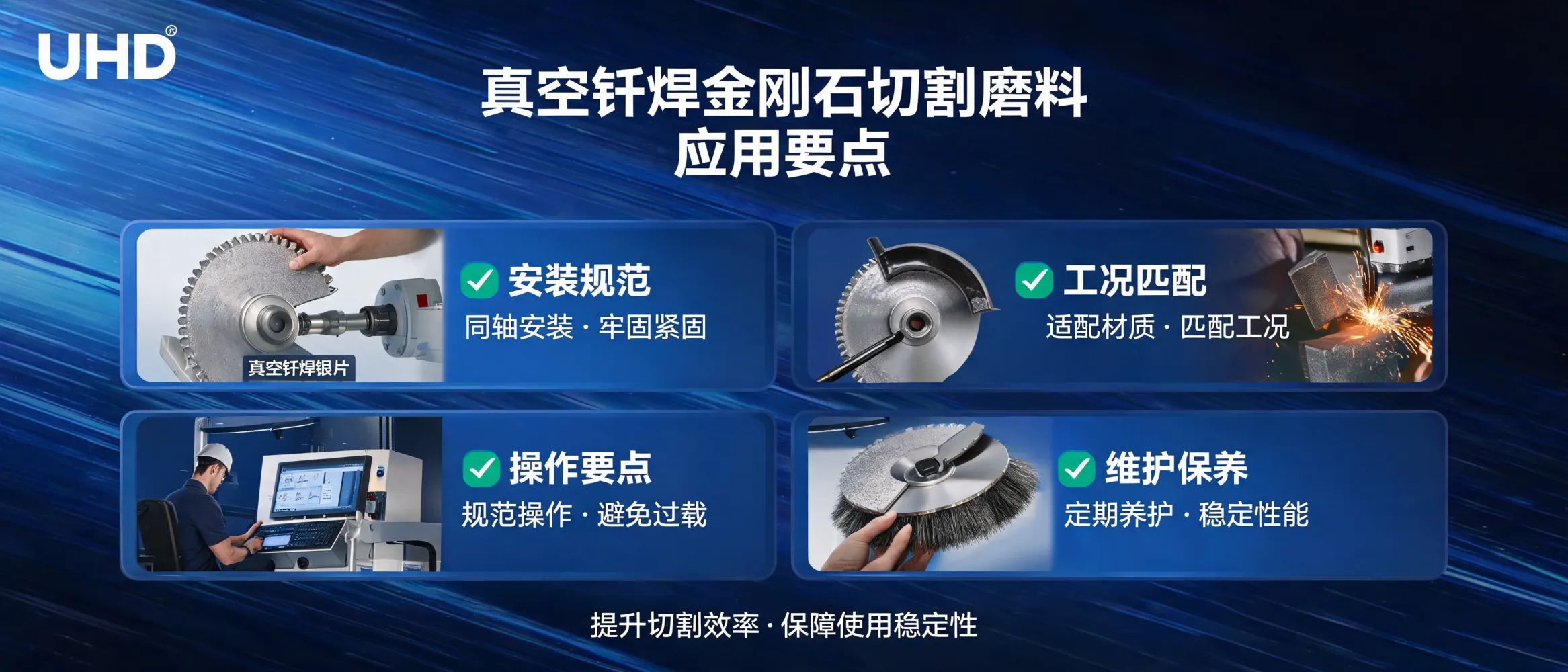
Installation quality is the baseline for safe, stable operation. Before starting production, implement a simple mounting checklist to reduce vibration, runout, and uneven contact—all of which directly reduce cutting efficiency.
Practical note: many premature issues attributed to “tool quality” are actually caused by mounting errors or unnoticed runout. A short pre-check often saves significant rework.
Process matching is the fastest lever for improving performance stability. For vacuum brazed diamond cutting abrasives, selection should reflect the workpiece material, the required operation (cutting, trimming, edge work, or grinding), and the workstation constraints (machine rigidity, fixture quality, and operator control).
| Matching factor | What to confirm | Why it matters |
|---|---|---|
| Workpiece material | Material category and surface condition (e.g., metal vs. stone; coating/oxide presence) | Affects required aggressiveness and heat generation risk, influencing stability and wear |
| Operation type | Cutting vs. edge shaping vs. grinding; desired finish vs. removal rate | Clarifies whether the setup should prioritize speed, control, or surface quality |
| Machine & fixture | Spindle stability, fixture rigidity, and repeatability | Insufficient rigidity increases vibration and uneven loading, reducing cutting efficiency |
| Operating environment | Dust control, coolant/use conditions (if applicable), and chip removal | Poor removal conditions can elevate heat and accelerate wear or instability |
If you provide your workpiece material, operation type, and machine model, UHD can support specification confirmation within the boundaries of your process requirements (B2B technical communication and supply coordination).
For vacuum brazed diamond cutting abrasives, stable operation typically comes from avoiding extreme swings in load and keeping the process consistent. Rather than chasing maximum aggressiveness, aim for a repeatable window that protects both the abrasive and the workpiece.
A simple maintenance routine helps maintain consistent performance and extends usable life by preventing small issues from turning into sudden failures.
Documentation tip: keep a light record of workpiece material, operation type, and observed wear/instability. Over time, this improves selection and helps avoid repeat mistakes.
| Observed issue | First checks | Typical cause category |
|---|---|---|
| Unstable cutting / strong vibration | Mounting interface cleanliness, runout, fixture rigidity | Installation / machine setup |
| Low efficiency / slow material removal | Process matching to material, load stability, chip/dust removal | Mismatch / operating conditions |
| Overheating signs (burn marks, odor) | Dwell time, continuous motion, removal conditions | Operation discipline / environment |
| Irregular wear / early damage | Shock loading events, improper installation, missed inspections | Improper use / maintenance gap |
As a high-tech enterprise focused on ultrahard material tools, UHD Ultrahard Tools Co., Ltd develops and supplies diamond tools, abrasives, and custom vacuum brazed diamond abrasives for industrial B2B customers. We collaborate with research partners (including universities) and maintain an export-oriented service workflow to support specification confirmation and application communication for different markets.
For a more accurate recommendation, prepare: workpiece material, operation type (cutting/grinding), machine model, fixture method, and your priority (efficiency, stability, or finish). This helps assess suitability for your specific cutting task and reduces avoidable loss from improper operation.
.png?x-oss-process=image/resize,h_1000,m_lfit/format,webp)


.png?x-oss-process=image/resize,h_1000,m_lfit/format,webp)