Stone Hardness Classification and Diamond Tool Selection: Mohs Scale Guide for Efficient Grinding
04 04,2026
Industry Research
This industry-focused guide explains how stone hardness classification—anchored in the Mohs scale and mineral composition—directly influences diamond tool selection in stone processing. It clarifies the performance impact of three core tool parameters: diamond concentration, grit size distribution, and bond (matrix) material, with practical links between stone physical properties and expected wear behavior. The article outlines a complete technical workflow from sample identification and hardness testing to trial runs, parameter tuning, and stable mass production, highlighting common pitfalls that lead to glazing, excessive wear, or low removal rates. It also introduces widely used empirical rules and pre-matching models to help engineering teams predict tool-stone compatibility before scaling up, improving grinding efficiency and consistency while reducing wasted consumables. Typical application cases cover key stone categories such as granite and marble, showing how tailored tool design resolves bottlenecks caused by hardness variability. For manufacturers and stone plants seeking repeatable results, UHD provides a structured path from test data to customized diamond tooling—contact UHD for tailored technical support.
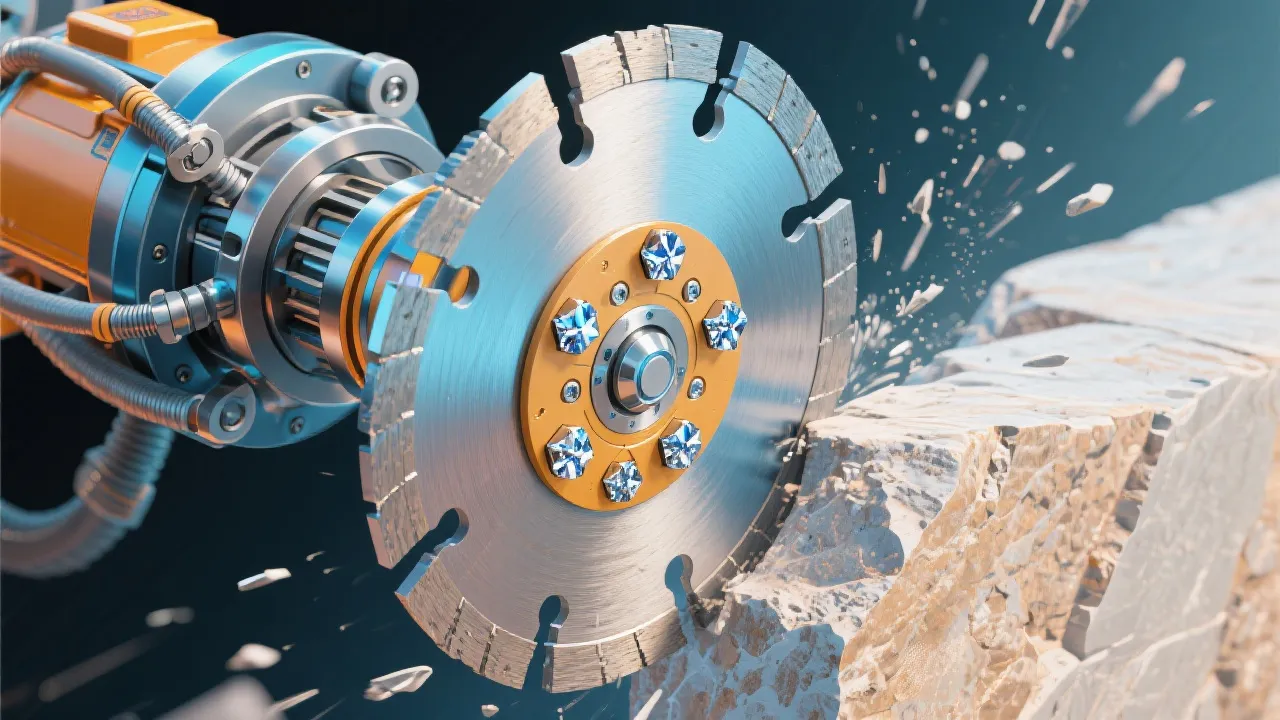
Stone Hardness Classification—and Why It Determines Your Diamond Tool Formula
In stone processing, “hardness” is often discussed as a simple number, but the real challenge is that stone hardness is a system: mineral composition, grain size, porosity, micro-cracks, and abrasiveness can turn two stones with similar Mohs values into completely different machining outcomes. For diamond tools, that difference shows up immediately as unexpected wear, glazing, slow stock removal, burn marks, or inconsistent finish.
This technical guide explains how the industry classifies stone hardness, how to interpret Mohs hardness alongside mineral content, and how to translate those findings into a practical diamond tool setup: diamond concentration, grit size distribution, and bond (matrix) selection—from sample testing to stable mass production.
1) Hardness Is Not Just Mohs: A Practical Classification for Stone Factories
Mohs hardness remains the most widely referenced scale in global stone trade because it’s intuitive and correlates with scratch resistance. However, for diamond tooling, Mohs is only the starting point. Two additional indicators matter just as much: abrasiveness (how quickly the stone dulls the tool) and cutting stability (how consistently the stone responds under load).
Common Stone Groups (Industry-Oriented View)
| Stone Group |
Typical Mohs Range |
Dominant Minerals |
Typical Tooling Risk |
| Marble / Limestone |
3–4 |
Calcite, dolomite |
Over-aggressive tooling can cause chipping & orange peel |
| Sandstone / Quartz-rich engineered surfaces |
6–7 |
Quartz, feldspar |
High abrasiveness → fast segment wear, heat management critical |
| Granite / Gabbro |
6–7+ |
Quartz, feldspar, mica |
Glazing when bond is too hard; burn marks at high pressure |
| Basalt / Dense volcanic stone |
6–7 |
Pyroxene, plagioclase |
High density → needs stable bond + controlled chip evacuation |
Practical note: in factory reality, “hard stone” usually means high quartz or high density, while “difficult stone” often means hard + abrasive + heat-sensitive finishing requirements.
For decision-making, many plants adopt a two-axis internal classification: (1) Mohs-based hardness and (2) abrasiveness proxy (quartz content, tool life observed per m², or segment wear rate per shift). This avoids a common mistake: selecting a “hard bond for hard stone” without realizing that a quartz-rich granite may require a different bond behavior than a dense, low-quartz basalt.
2) The Three Diamond Tool Parameters That Actually Move Your KPI
Diamond tools are often compared by “sharpness” or “life,” but production lines care about measurable KPI: m²/hour, tool cost per m², and reject rate. In most stone lines (calibration, grinding, polishing prep), three parameters dominate outcomes.
A) Diamond Concentration (How Many Cutting Points You Keep Alive)
Higher concentration usually increases potential tool life, but can reduce chip space and promote heat buildup. For soft stones (e.g., marble), too high a concentration can lead to rubbing instead of cutting. For abrasive granites, too low a concentration accelerates segment wear and drives unstable finish.
Field reference: many factories see 10–25% productivity swings from concentration changes alone when other variables are fixed (machine pressure, coolant, RPM).
B) Grit Size & Distribution (How You Balance Stock Removal vs. Surface Control)
Coarser grit increases stock removal but raises the risk of deep scratches and edge chipping; finer grit reduces scratches but can glaze if the bond is not shedding correctly. In real lines, the distribution (narrow vs. mixed) matters: a slightly mixed distribution can stabilize cutting on heterogeneous stones where “hard spots” appear across slabs.
Useful benchmark: if scratch complaints rise after switching stone batches, it’s often not “grit too coarse” alone—it can be grit + bond mismatch causing diamond pullout or glazing.
C) Bond / Matrix Material (How Fast the Tool Self-Sharpens)
Bond behavior is the hidden lever. A “hard” bond retains diamonds longer but can glaze on dense granite; a “soft” bond exposes fresh diamonds quickly but can disappear on quartz-rich stones. Many performance failures come from assuming bond hardness should mirror stone hardness. In practice, the guiding idea is: the bond must wear at a controlled rate to keep diamonds working.
3) From Sample Test to Mass Production: A Repeatable Technical Workflow
A reliable diamond tool program is less about “one perfect formula” and more about a controlled loop: test → measure → adjust → lock parameters. Below is a workflow used by many high-output stone plants and tool makers.
Step-by-step Control Points (What to Record, Not Just What to Do)
- Stone sampling & labeling: record quarry/source, batch date, slab thickness, moisture condition, visible veins, and resin status (if applicable).
- Quick hardness + abrasiveness screening: Mohs reference scratch + proxy indicator (e.g., quartz estimate, density, or existing segment wear from baseline tool).
- Pilot run under stable machine settings: fixed line speed, fixed pressure window, consistent coolant flow. Avoid “operator compensation” during test.
- Measure 4 core metrics: stock removal rate (mm or g/min), power draw trend, surface defect rate, and tool wear per m².
- Parameter adjustment logic: if glazing → soften bond / adjust concentration; if fast wear → harden bond / increase concentration; if deep scratches → refine grit or stabilize distribution.
- Pre-production validation: run at least 1–2 shifts to check consistency; many issues only show after thermal equilibrium.
- Mass production lock: document final formula, segment height tolerance, sintering consistency, and incoming QC criteria for diamonds and powder.
Typical outcome: a structured trial reduces “trial-and-error cycles” by 30–50% compared with informal adjustments, especially when multiple stone batches are processed each month.
A common pitfall is skipping the “stable machine settings” rule. When operators adjust pressure and water during a test, the tool may look acceptable—but the formula won’t transfer to other lines or other shifts. That’s why experienced teams treat tooling tests like process validation: controlled inputs, measurable outputs.
4) Experience Formulas & Fit Prediction: Turning Know-how into a Decision Model
In diamond tooling, “experience” becomes powerful when it’s written down as a repeatable rule. Many factories use simple predictive models to shortlist candidate formulas before expensive trials.
A Practical Prediction Framework (Used for Pre-Selection)
A commonly used approach is to define a Stone Machinability Index (SMI) that combines hardness and abrasiveness:
SMI ≈ 0.55 × Mohs + 0.45 × Abrasiveness Score
Abrasiveness Score can be estimated from quartz content (e.g., 0–10 scale) or from baseline wear rate vs. a reference granite.
Then map SMI to initial tooling choices:
- Low SMI: prioritize surface control, reduce aggressiveness, avoid over-cutting.
- Mid SMI: balanced concentration and a medium bond to maintain stable self-sharpening.
- High SMI: protect against rapid wear; manage heat; consider higher concentration and bond engineered for controlled shedding.
This is not meant to replace trials; it’s meant to reduce the first-round miss rate. In plants processing mixed granite colors, a simple index can prevent selecting a bond that glazes on dense black granites or one that melts away on quartz-rich light granites.
5) Typical Application Cases (What “Mismatch” Looks Like in Production)
Case A: Granite Line Slows Down After a New Batch
Symptom: feed rate drops, power draw rises, tool face looks shiny (glazing). Root cause is often a bond too hard for the batch’s density or microstructure, even if Mohs is unchanged. Fix strategy: adjust bond to renew cutting edges, or stabilize grit distribution to handle hard spots—then re-check power trend over a full shift.
Case B: Marble Finishing Shows Chipping on Edges
Symptom: edge micro-chips and “peel” texture. This is frequently linked to excess aggressiveness: grit too coarse, concentration too high, or insufficient damping from the bond. Fix strategy: step down grit earlier, reduce cutting point density, and ensure coolant reaches the contact zone consistently.
Case C: Fast Segment Wear on Quartz-Rich Stone
Symptom: tool life collapses, segments lose height quickly, surface quality is unstable. This is a classic abrasiveness-driven failure. Fix strategy: raise concentration, engineer bond to resist rapid erosion, and manage heat—because excessive temperature accelerates matrix breakdown and diamond pullout.
6) Interactive Q&A (Designed for Engineers and Purchasing Teams)
Q1: If a stone has higher Mohs hardness, should the bond always be harder?
Not always. The bond must match wear behavior, not just scratch resistance. Dense stones may require a bond that sheds to prevent glazing, while quartz-rich stones may require a bond that resists abrasion to avoid rapid loss.
Q2: What’s the fastest way to detect a mismatch during trial?
Watch power draw trend + tool face condition. Glazing typically shows rising power and a shiny tool surface; fast wear shows falling segment height per m². Combine that with defect rate (scratches/chips) to identify whether the issue is grit, concentration, or bond.
Q3: How many samples are needed before scaling to mass production?
Many operations validate with 2–3 slabs for initial screening, then confirm over one full shift for stability. If the stone source is variable, a second batch confirmation is recommended before locking the formula.
Q4: Which data should be shared with a tool supplier to speed up customization?
Provide stone name/source, slab thickness, target finish, machine model, line speed, pressure window, coolant type/flow, current tool parameters, and at least one record of tool wear per m² plus photos of wear pattern. This enables faster prediction and fewer trial loops.
Content Formats That Increase Technical Trust (and Lead Quality)
Factory-Friendly Charts
Add a one-page chart mapping stone groups to initial concentration/grit/bond recommendations, and a troubleshooting matrix (glazing vs. fast wear vs. scratches). These assets are frequently saved and shared internally by plant managers.
Short Process Videos
A 60–90 second clip showing stable test conditions, measurement points, and wear-pattern reading often answers more questions than a long brochure—especially for overseas buyers comparing suppliers.
Whitepaper Download
Offer a downloadable checklist: required stone data, trial log template, and acceptance criteria for mass production. This typically improves inquiry quality because prospects submit actionable parameters upfront.
Need a Faster Match Between Stone Hardness and Tool Performance?
UHD supports stone factories and machinery manufacturers with custom diamond tool formulation based on your stone hardness classification, mineral composition, and line conditions—so you can reduce trial cycles, stabilize wear, and protect throughput.
Contact UHD for customized diamond tool technical support
Recommended to share: stone type/batch, target finish, machine model, pressure & speed range, coolant info, and current tool wear data.


.png?x-oss-process=image/resize,h_1000,m_lfit/format,webp)
.png?x-oss-process=image/resize,h_1000,m_lfit/format,webp)